
US stocks edged lower from their record highs on Monday, while oil prices climbed as uncertainty remained over when the Strait of Hormuz could reopen and restore global crude shipments.
The S&P 500 declined 0.1% from Friday’s record close. The Dow Jones Industrial Average fell 60 points, or 0.1%, while the Nasdaq Composite dropped 0.3%.
Markets pause after strong earnings rally
Stock market momentum slowed following a strong rally driven by better-than-expected corporate earnings. According to FactSet, earnings per share for S&P 500 companies are on track to rise 50% year over year in the second quarter, marking the strongest growth rate in five years.
Berkshire Hathaway was among the latest companies to report stronger-than-expected results. The company, built by legendary investor Warren Buffett, also revealed that it had invested part of its large cash reserves into stocks under new CEO Greg Abel.
Berkshire Hathaway shares gained 1.5% as strong earnings helped offset concerns that US stocks appear expensive.
Corporate deals drive individual stock moves
Several companies saw significant moves following acquisition announcements:
- MarineMax surged 46.1% after the retailer, marina operator and superyacht services provider agreed to be acquired for approximately $1.5 billion in cash by a Blackstone portfolio company.
- Varex Imaging jumped 48.8% after Teledyne Technologies announced plans to acquire the X-ray imaging component manufacturer for $18.90 per share in cash.
- Intel declined 4.1% after announcing it may sell $15 billion worth of shares to raise capital for artificial intelligence investments. The move could dilute existing shareholder ownership.
Overall, the S&P 500 fell 4.53 points to 7,753.11. The Dow Jones Industrial Average declined 60.95 points to 53,975.98, while the Nasdaq Composite dropped 85.26 points to 26,605.36.
Oil prices climb amid Hormuz uncertainty
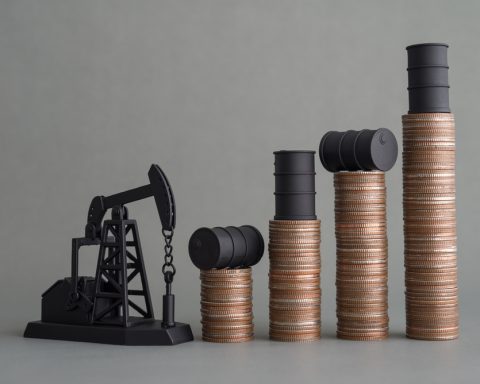
Oil prices rose as investors reassessed the possibility of a quick reopening of the Strait of Hormuz. Brent crude increased 5% to $87.72 per barrel.
The benchmark crude price has moved between $72 and $102 per barrel in recent months as expectations have shifted over whether the United States and Iran could reach an agreement allowing oil tankers to resume normal operations.
Higher oil prices increase inflation risks, making Wednesday’s US inflation report the key economic event for markets this week. Economists expect inflation to slow slightly to 3.4% in July from 3.5% in June.
Fed rate outlook remains uncertain
A slowdown in inflation would reduce pressure on the Federal Reserve to raise interest rates. While higher rates can help control inflation, they also increase borrowing costs for households and businesses and can weigh on stock valuations.
Last week’s weaker-than-expected US employment report lowered expectations for a near-term rate increase. However, traders still see around a 52% chance that the Fed will raise its benchmark rate at its September meeting, according to CME Group data.
The yield on the 10-year US Treasury note increased to 4.70% from 4.65% late Friday. The yield remains significantly above its level before the conflict with Iran began, contributing to higher mortgage and borrowing costs.
Global markets mixed
International markets were mixed on Monday. European indexes traded unevenly after gains across much of Asia.
Japan’s Nikkei 225 advanced 2.1%, marking one of the strongest performances among major global markets.