
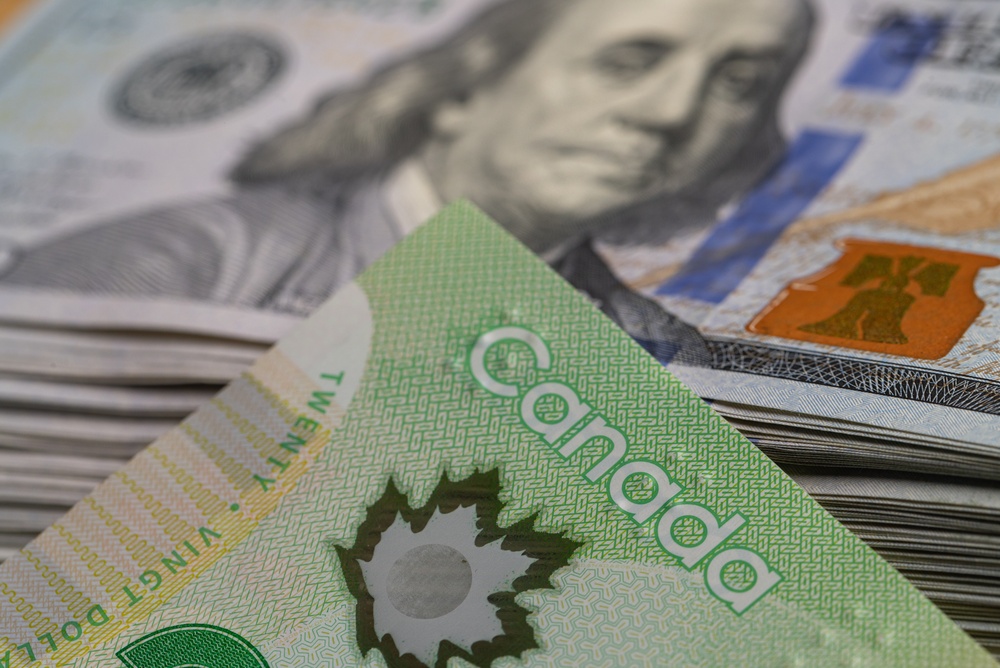
Loonie Stabilizes After Recent Weakness
The Canadian dollar steadied near a multi-week low against the U.S. dollar on Tuesday, as weak domestic economic data and uncertainty over upcoming trade talks continued to weigh on sentiment.
The loonie traded nearly unchanged at 1.3838 per U.S. dollar, or 72.26 U.S. cents, after moving between 1.3816 and 1.3854. Last Thursday, the currency touched a six-week low of 1.3869.
Soft Data Weighs On The Currency
Canada’s recent economic figures have added pressure to the currency.
Data released Friday showed that gross domestic product declined at an annualized rate of 0.1% in the first quarter, following a downwardly revised contraction of 1% in the previous quarter.
Technical Recession Concerns Persist
The two consecutive quarterly declines have raised concerns that Canada entered a marginal technical recession at the start of the year.
Trade uncertainty has weighed on business investment, while slower domestic momentum has left investors questioning whether the Canadian economy can regain traction quickly.
U.S. Economy Looks Stronger
Tony Valente, senior FX dealer at AscendantFX, said the Canadian dollar remains under pressure as softer oil momentum collides with a resilient U.S. dollar and a widening growth gap.
He noted that while the U.S. economy continues to surprise to the upside, Canada is coming off a weak start to the year, and the Bank of Canada appears limited in its ability to respond.
Bank Of Canada Expected To Hold
Investors expect the Bank of Canada to keep its benchmark interest rate unchanged at 2.25% for a fifth consecutive meeting next week.
Swap market pricing suggests traders do not expect policymakers to respond immediately to the latest GDP weakness, especially while trade and inflation risks remain uncertain.
CUSMA Review Adds Uncertainty
The upcoming review of the United States-Mexico-Canada Agreement is another source of pressure for the loonie.
The trade pact, known as CUSMA in Canada, has protected much of Canada’s exports from U.S. tariffs. It is set for review by July 1, creating uncertainty for businesses and currency markets.
Canada Seeks Longer Renewal
Canada has sent a letter to the United States and Mexico outlining recommendations to renew the trade agreement for 16 years.
Ottawa is also seeking parallel talks on sectoral tariffs ahead of a meeting between Canadian and U.S. trade negotiators.
Tariff Risk Limits Loonie Upside
Valente said the July CUSMA review and the ongoing threat of new U.S. tariffs leave the Canadian dollar without a strong positive catalyst.
For currency traders, the loonie remains vulnerable as long as trade uncertainty combines with weaker Canadian growth and firm U.S. dollar demand.
Oil Offers Limited Support
Oil prices rose on Tuesday, which would normally help the Canadian dollar because crude is one of Canada’s major exports.
The U.S. price of oil increased 1.5% to 93.55 dollars a barrel, but remained near the lower end of its recent range, limiting its support for the loonie.
Bond Yields Stay Subdued
Canada’s 10-year yield was nearly unchanged at 3.423% after earlier touching 3.394%, its lowest level since April 8.
The subdued yield backdrop reflects caution over Canada’s growth outlook and reinforces the view that the currency may struggle without stronger domestic data, clearer trade signals or a more sustained oil rebound.