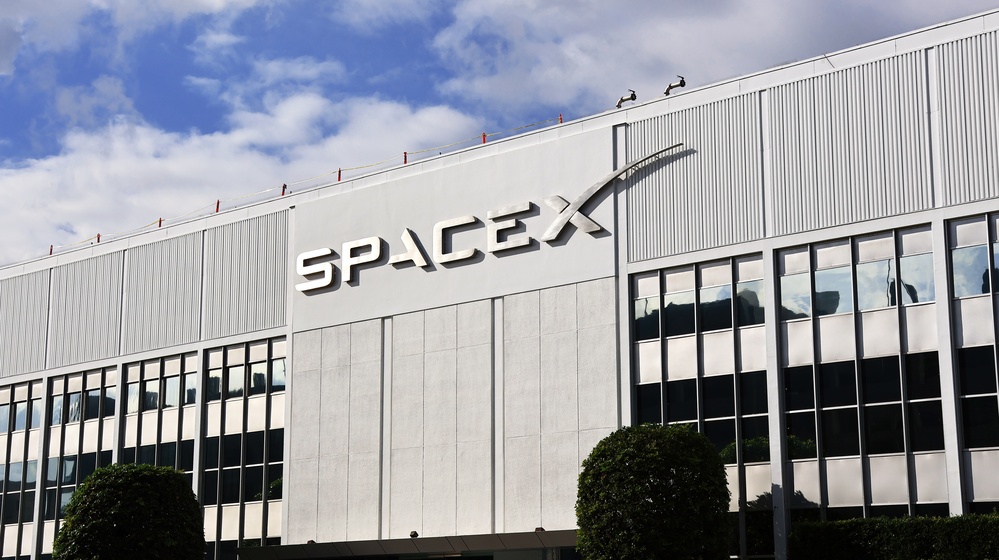
SpaceX surged during its first day of trading on Friday as investors competed for shares in Elon Musk’s space, satellite internet and artificial intelligence group.
The stock opened at $150 and later traded near $166, representing a gain of roughly 23% from the $135 IPO price established on Thursday.
That performance pushed the company’s market value above $2 trillion and made it the sixth-largest publicly traded company in the United States.
A major test for future technology listings
The debut is being closely watched as a possible preview of the next generation of enormous technology offerings.
Market participants are looking to SpaceX for evidence that investors remain willing to support highly valued growth companies ahead of expected listings from artificial intelligence leaders such as Anthropic and OpenAI.
Some bankers warned that the broader IPO market could have suffered if SpaceX had ended its first session below the $135 offering price.
Musk becomes the first trillionaire
The listing further increased the value of Musk’s holdings and cemented his status as the first person whose fortune has exceeded $1 trillion.
The milestone came despite SpaceX reporting a loss of nearly $5 billion last year and generating far less revenue than other technology companies with comparable valuations.
Investors appear willing to pay an exceptional premium for Musk’s record of identifying major technology trends and turning ambitious projects into commercial businesses.
Sequoia investment delivers enormous return
Shaun Maguire, a partner at Sequoia Capital who led the firm’s investment in SpaceX, said Musk deserved an unusually high valuation because of his vision and execution.
At the IPO price, Sequoia’s approximately $2 billion investment would be worth more than $20 billion, according to a person familiar with the figures.
Executives open the Nasdaq session
SpaceX President Gwynne Shotwell and Chief Financial Officer Bret Johnsen rang the Nasdaq opening bell before trading began.
The ceremony marked the culmination of Musk’s long-standing ambitions in space and technology and formally brought one of the world’s most closely watched private companies into the public market.
A $75 billion fundraising record
SpaceX raised $75 billion through the offering, more than twice the amount collected by Saudi Aramco in its record-setting 2019 IPO.
The company’s valuation could increase further if underwriters exercise their option to sell additional shares, a decision that is generally made within 30 days of an offering.
Nasdaq 100 inclusion could create more demand
Although SpaceX may have to wait before qualifying for the S&P 500, it is expected to enter the Nasdaq 100 through the index’s accelerated inclusion rules.
The process could take about one month, compared with a traditional waiting period of up to a year.
Once added, SpaceX would become a significant holding for index funds and exchange-traded funds that track the Nasdaq 100, creating another source of demand for the shares.
Investors compare Musk with historic entrepreneurs
Joel Shulman, chief executive of ERShares, said few modern entrepreneurs offer a meaningful comparison with Musk.
He described the SpaceX founder as an exceptional visionary who has repeatedly demonstrated an ability to execute on unusually ambitious ideas.
ERShares manages an exchange-traded fund with exposure to the company.
Portfolio reshuffling pressures other space stocks
SpaceX’s arrival could force some investment funds to reduce holdings in other large technology companies to make room for the new stock.
Shares of several space and satellite businesses fell sharply on Friday, reversing gains that followed SpaceX’s IPO filing in April.
Planet Labs declined 8%, while EchoStar dropped 14% as investors redirected attention and capital toward the newly listed market leader.
SpaceX claims a $28.5 trillion opportunity
Despite the market excitement, calculating a reasonable value for SpaceX remains difficult.
The company estimates that its potential market spans $28.5 trillion, which it describes as the largest commercial opportunity in human history.
SpaceX says its operations accounted for more than four-fifths of the total mass launched into orbit during the past three years.
Its leadership in rocket launches, combined with recurring revenue from Starlink, gives the company an established platform from which to pursue newer businesses.
Tesla offers the closest comparison
John Belton, portfolio manager at Gabelli Funds, said Tesla may be the most useful comparison for valuing SpaceX.
Both companies combine a proven operating business with a much more speculative opportunity that could become significantly larger in the future.
For Tesla, that opportunity includes humanoid robots and other emerging technologies. For SpaceX, investors are increasingly focused on artificial intelligence.
Valuation reaches 94 times revenue
SpaceX generated $18.7 billion in revenue during 2025.
At its current market capitalization, the company trades at approximately 94 times annual revenue, an extremely high multiple even by the standards of large technology businesses.
Morningstar analysts estimated this month that the company’s fair value is closer to $780 billion, well below the valuation reached in its market debut.
CFRA began covering SpaceX on Friday with a sell recommendation.
Investors are buying the long-term vision
Nancy Tengler, chief executive and chief investment officer at Laffer Tengler Investments, said SpaceX is not a company investors purchase based primarily on traditional financial measures.
She compared the opportunity with Amazon, which carried a high valuation while building businesses that eventually changed consumer behaviour and the broader economy.
Tengler said even a decline toward $100 would not necessarily alter her firm’s long-term view, because it wants exposure to the company’s potential transformation of space and AI markets.
A record listing with enormous expectations
SpaceX’s first trading session confirmed the extraordinary demand surrounding Musk’s business empire.
The company now has to justify a valuation above $2 trillion while expanding Starlink, maintaining its dominance in launches and developing an AI business that investors believe could unlock a far larger market.
Its performance will also influence confidence in the broader IPO pipeline, particularly for the highly valued artificial intelligence companies expected to follow it onto public markets.